Prof. Jim O'Mahony
Munster Technological University, Cork, Ireland
Working Title: Gen AI - Opportunities and Challenges in Education


We are excited to announce that the EAPRIL 2026 Conference will be organised at the Clayton Hotel Silver Springs in the beautiful city of Cork from November 24-26, 2026!
Please note that you can book a hotel room at the conference venue Clayton Hotel Silver Springs at an EAPRIL promotional rate. Contact info@eapril.org if you wish to receive the promotion code and more details.

The registrations for the EAPRIL 2026 conference are now open, register here.
Important deadlines:
! Please note that we’ve switched to a new registration platform: PheedLoop for the EAPRIL 2026 Conference registrations.
You can find an overview with the registration steps explained here.
Please note: A transaction fee of 1.9% will be added to all registration fees.
All registrations must be completed individually and paid online by credit card at the time of registration. Please note that EAPRIL is unable to issue invoices for registration payments, nor do we work with purchase orders.
If you have any questions, issues, or concerns during the sign-up or registration process, please don’t hesitate to get in touch with us on info@eapril.org — we’re happy to help!
23 February
3 May (extended from 24 April)
27 May (extended from 12 May)
10 June (extended from 27 May)
15 June (extended from 4 June)
1 July
9 September
16 September
24 - 26 November
We are pleased to share the preliminary programme for the EAPRIL 2026 Conference. Please note that the schedule is subject to change, but it already offers a first overview of the planned sessions and social events.
We look forward to welcoming you to EAPRIL 2026!
Making meaning: The craft of collaborative construction of understanding
Education has always been a space where meaning is made rather than simply delivered. Yet the question of how meaning emerges in educational practice and research has become increasingly pressing. Across sectors and across the lifespan, educators and researchers are navigating growing complexity, new technologies, shifting societal expectations and persistent inequalities. Within this landscape, EAPRIL continues to cultivate a community where practice and research meet as equal partners in the shared work of improving education.
The 2026 conference in Cork invites participants to explore education as both a scholarly field and a professional craft. The metaphor of craft reminds us that education is shaped through experience, judgement, collaboration and reflection. It acknowledges that knowledge is not only produced in formal research settings but also in classrooms, workplaces and professional learning environments. Bringing these perspectives together has long been central to EAPRIL, and the conference seeks contributions that deepen this dialogue and strengthen the bridges between research and practice.
EAPRIL 2026 aims
to create a space for dialogue, reflection and collaboration. The conference in
Cork invites the community to explore how meaning is crafted across educational
contexts and how the partnership between practice and research can continue to
evolve in ways that benefit learners, professionals and society.
Read more on the 2026 conference theme here!
We will have the pleasure of hearing inspiring keynote speeches from the following speakers:
Munster Technological University, Cork, Ireland
Working Title: Gen AI - Opportunities and Challenges in Education

University of Luxembourg, Luxembourg
Working Title: Your attention, please! - Teaching and Learning in Times of Distraction

Fontys University of Applied Sciences, The Netherlands

We’re excited to announce that school visits will once again be part of the EAPRIL 2026 pre-conference programme!
When? Monday, 23 November, from approximately 8:30 to 12:30
Price? €45 per person (VAT excluded)
Together with our local partners in Cork, we are currently organising a range of inspiring school visits, offering participants valuable insights into real educational settings. These visits provide a unique opportunity to explore teaching practices and educational environments across different levels. Tickets are available for visits to three educational levels: Kindergarten, Primary Education, and Secondary Education.
Tickets are available through the registration portal while registering.
So far, three schools have have confirmed their participation:
(1) Primary education schools: Gaelscoil Na Dúglaise and Scoil Íosagáin
(2) Secondary education school: Christian Brothers College
Find out more about the schools in this brochure.
We expect to add more schools to the programme, as several are still considering our invitation. The final selection of schools will depend on the number of tickets sold for each educational level.
Besides the school visits, we also offer a tour of University College Cork at the reduced price of €8 per person.
When? Monday, approximately 08:30–11:30
Tickets must be purchased through the registration portal (not through University College Cork).
We hope you will join us for this enriching experience.

We are delighted to invite all conference participants to the EAPRIL Conference Dinner.
When? Wednesday, 25 November at 19:30
Where? The Metropole Hotel Cork, MacCurtain Street, Victorian Quarter, Cork, T23 EEC3
Price? 90 EUR per person (VAT excluded)
The conference dinner will take place at the historic Metropole Hotel Cork, located in the heart of the city's vibrant Victorian Quarter. Surrounded by boutique shops, cafés, and entertainment venues, and just a short walk from Patrick Street, Cork's main shopping district, and Kent Railway Station, the hotel offers the perfect opportunity to enjoy a brief visit to Cork city centre.
For more than 125 years, the Metropole Hotel Cork has been renowned for its timeless Victorian elegance and warm Irish hospitality, making it one of Cork's most distinguished venues for celebrations and special events.
Guests will enjoy a dinner prepared with sustainably sourced, high-quality local ingredients, served in the hotel's magnificent Ballroom overlooking the River Lee. With its elegant setting and sweeping river views, the Ballroom provides a memorable backdrop for the EAPRIL Conference Dinner.
Please note that you can reserve bus transportation to and from the Clayton Silver Springs Hotel during registration. This transportation is included with your conference dinner ticket; however, we ask you to add the bus ticket to your registration so we can estimate how many attendees will require transportation.
Travel by
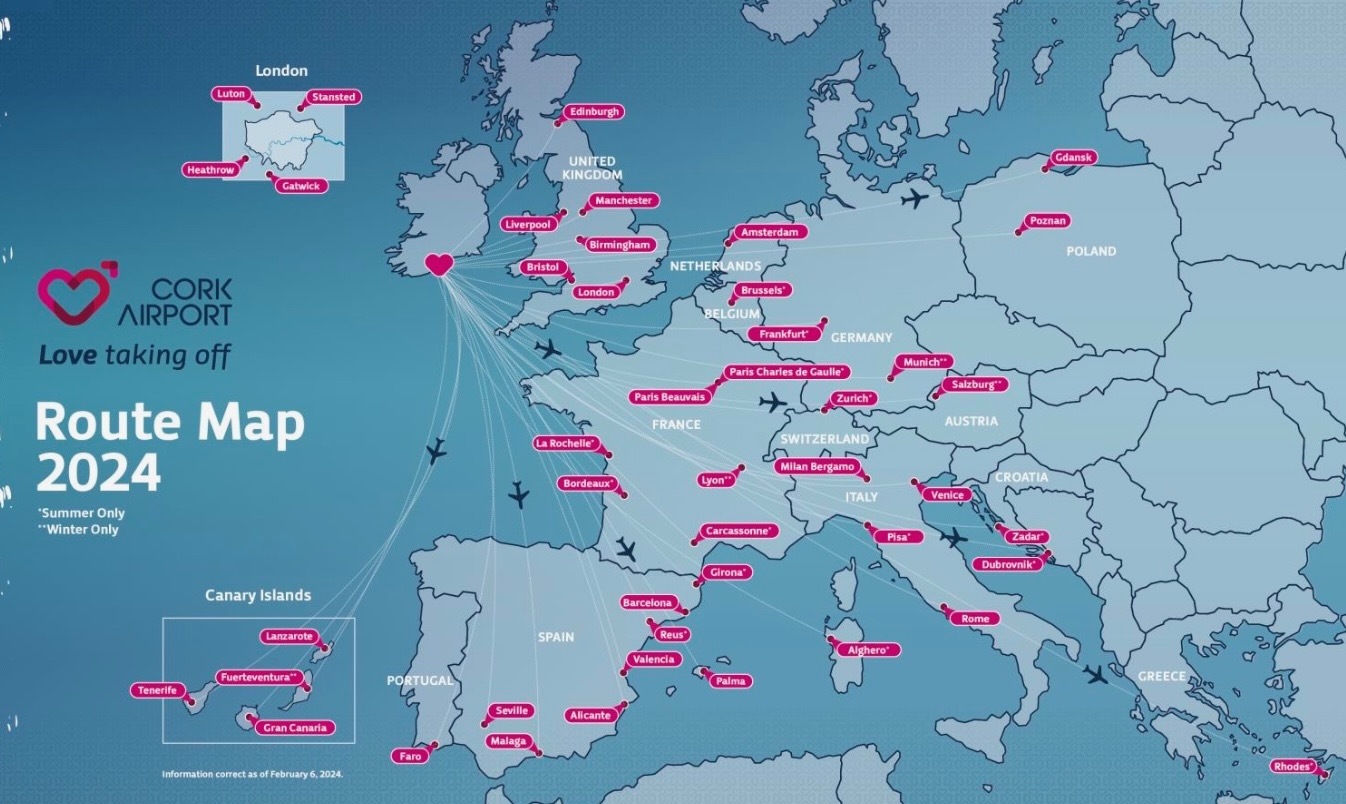
Air: Regarded as the international gateway to the South of Ireland, Cork Airport is the country’s second busiest and best-connected international airport with connectivity to over 30 destinations. This includes direct flights to most major European cities including London, Edinburgh, Rome, Paris, Amsterdam, Zurich, Barcelona, Frankfurt and many more.
And not forgetting the options of stopover flights or travelling from the nearby Dublin, Shannon and Kerry Airports which further expands Cork’s connectivity with the rest of Europe and the world.
Ferry: Located just 15km from Cork City centre, our ferry terminal offers easy access to and from mainland Europe. Brittany Ferries operate daily services between Cork-Roscoff (France) and Cork-Santander in (Spain).
Cork is also accessible via ferry from Rosslare and Dublin. Both ports offer daily services between Ireland-UK and are just a 3-hour drive away via car/bus. Operators at these ports include Irish Ferries, Stenaline and P&O Ferries.
Accommodation
You can book your accommodation at the host hotel or one of their sister hotels at an EAPRIL promotional rate:
Please note: These hotels are holding rooms specifically for EAPRIL delegates until 24 September 2026. After this date, rooms will be subject to general availability and allocated on a first-come, first-served basis for the conference dates.
You can find the details and promotion codes for your hotel booking in the Speaker Portal and in your registration confirmation email. Please contact EAPRIL Office (info(at)eapril.org) if you have questions.
Submissions for the EAPRIL 2026 conference are closed!
Guidelines
Consult our general submission guidelines below.
For format-specific guidelines, click on the highlighted name of each format below. We accept various forms of submission proposals (e.g., present & discuss, symposium, workshop, case study, roundtable, poster, and award).
To accommodate conference participants who require a full paper peer review, we now offer an additional format: Present & Discuss (full paper peer-reviewed). However, during the conference and presentations, there will be no distinction between the different present & discuss formats:
For detailed guidelines and submission criteria for this new format, please review the specific guidelines carefully.
Accordingly, our conference proceedings will contain:
Submit your EAPRIL 2026 proposal
Submit for EAPRIL 2026 Best Practice-Based Research Award
Submissions in the Pheedloop System: A Step-by-Step Guide

Present & discuss sessions allow delegates to present their research and findings in an in-depth manner. These presentations are individually submitted and have data and results to present. Three Present & Discuss proposals are clustered together, based on similarities in topic, methodology and/or objectives. Each presenter is offered 15 minutes presentation time followed by 10 minutes for questions and discussion. At the end of all presentations, a 15-minute collective discussion is organised by the chair.
Present & Discuss sessions consist of 3 linked presentations that are scheduled together in a 90-minute session.
Please note that during the conference, no distinction will be made between abstract-reviewed and full paper peer-reviewed Present & Discuss presentations. All presentations will be grouped and scheduled into sessions based on topic and theme similarity.
Present & discuss sessions allow delegates to present their research and findings in an in-depth manner. These presentations are individually submitted and have data and results to present. Three Present & Discuss proposals are clustered together, based on similarities in topic, methodology and/or objectives. Each presenter is offered 15 minutes presentation time followed by 10 minutes for questions and discussion. At the end of all presentations, a 15-minute collective discussion is organised by the chair.
Present & Discuss sessions consist of 3 linked presentations that are scheduled together in a 90-minute session.
Please note that during the conference, no distinction will be made between abstract-reviewed and full paper peer-reviewed Present & Discuss presentations. All presentations will be grouped and scheduled into sessions based on topic and theme similarity.
Please note that all submissions must be original and not simultaneously submitted to another journal or conference.

Symposia provide an opportunity to present research on one topic, often from multiple perspectives, through a coherent set of papers. Symposia sessions are directed by a chair, involving three presenters and one discussant. Each presenter will be offered 15 minutes to present their research. Afterwards, the discussant has 15 minutes to present their reflections on the preceding presentations and to introduce one or two general statements to the delegates. This is followed by a general 30-minute discussion to discuss the theme of the symposium and the related statements in-depth.
Please bear in mind the three-country-rule where the symposium participants (chair, discussant, presenting authors) need to represent at least three different countries.

Workshops are a highly interactive, collaborative session format that shows the application of the outcomes of a research project. Learning-by-doing, hands-on experience and engaging in in-depth active learning are central characteristics of workshops. Creative and/or innovative approaches are encouraged, such as brainstorming, associating, panel discussion, role play, debating, voting on statements, think tank, flipping-the-classroom, systemic approaches, simulations, mystery guest and so on. Please consider any type of media to support interactivity.
Workshops are scheduled for 90 minutes.

In a case study session practitioners are invited to present a case from practice. A research component can be added to this session, but this is not a required condition. Instead, the floor is given to practitioners who wish to share their experiences when designing, implementing or evaluating a practice in class / school / college / university / workplace. In this format, there is more time for reflection and in-depth discussion about the case via a hands-on approach. Within one session two thematically linked case studies are clustered together. Each practitioner is offered 20 minutes to present their case followed by 25 minutes that are dedicated to an in-depth discussion with the audience.
A case study session consists of two linked case studies and is scheduled for 90 minutes.

A roundtable session focuses on unfinished or starting projects. In other words, the research projects don't have to have actual results but can be starting or early research. This type of session will not be set-up as a formal presentation but rather as a talk between colleagues. No formal presentation by means of a slideshow presentation is expected. Instead, a 1 A4-handout is advised for the participants of your session that summarises the main ideas and questions central in the discussion. Each presenter will be offered 15 minutes to outline both the main ideas and objectives of the project, as well as the question, problem and/or challenge(s) that they want to present to the audience. This is followed by a 30-minutes discussion per research project.
Two submissions are scheduled together in a timeslot of 90 minutes.

A poster communicates the main ideas, objectives, results and conclusions of an ongoing research project or study. Posters provide a great starting point for discussion about your work with interested and knowledgeable researchers. Each presenter will be given 3-5 minutes to present his/her poster. Afterwards, the delegates have time to ask questions or start an in-depth discussion with the presenters. Finally, a general discussion (10-15 minutes) will take place in which the main ideas, conclusions and directions for future research and practice are discussed.
A number (circa 3-5) of posters are clustered thematically in a session of 90 minutes.

The EAPRIL Best Practice-Based Research Award wishes to acknowledge an outstanding and innovative project that deals with learning and development in the workplace and educational field. More specifically, practice-based research which has a profound impact on the development of both theory and practice is particularly of interest.
At the EAPRIL Conference the nominated projects get the chance to present their project during an exclusive plenary Award Session. The winner will be announced on the last day of the conference.
When the submission deadline has passed the review process will start. This process consists of two rounds.
PROCEDURE
After the submission deadline has passed on 3rd of May 2026 (extended from 24th of April) the first review round will start, which will run until 27th of May 2026 (extended from 12th of May). In the first round all proposals will be blind-reviewed by two reviewers.
For those submissions that yield discrepant review results, a second review round will be organised between 27th of May 2026 and 10th of June 2026. In the second round all proposals that received a discrepant result in the first round will be blind-reviewed by a third reviewer. Only a few reviewers will be asked to participate in this second review round.
While submitting, please also consider signing up as a reviewer!
The reviewers can download the review guidelines below.
The EAPRIL Board of Directors is committed to being an inclusive community and wants to provide the opportunity to researchers with little access to funds to also present and attend the EAPRIL conference. Therefore, we are continuing with the funding for presenters initiative meaning that we can again offer a waived conference fee for two conference delegates.
You are considered eligible for the waived conference fee if you match the four following criteria:
After the EAPRIL 2026 review process is completed, the two highest-scoring eligible Present & Discuss (full paper peer-reviewed) proposals will be awarded a waived conference registration fee for the EAPRIL 2026 conference.
The full list of countries qualifying as low-GDP for 2026 is provided below in alphabetical order:
A | Afghanistan, Albania, Algeria, American Samoa, Angola, Antigua and Barbuda, Arab Republic of Egypt, Argentina, Armenia, Azerbaijan. |
B | Bahrain, Bangladesh, Barbados, Belarus, Belize, Benin, Bhutan, Bolivia, Bosnia and Herzegovina, Botswana, Brazil, Bulgaria, Burkina Faso, Burundi. |
C | Cabo Verde, Cambodia, Cameroon, Central African Republic, Chad, Chile, China, Colombia, Comoros, Costa Rica, Cote d'Ivoire, Croatia, Cuba, Curaçao. |
D | Democratic People’s Republic of Korea, Democratic Republic of Congo, Djibouti, Dominica, Dominican Republic. |
E | Ecuador, El Salvador, Equatorial Guinea, Eritrea, Eswatini, Ethiopia. |
F | Federal Republic of Somalia, Fiji, French Polynesia. |
G | Gabon, Gambia, Georgia, Ghana, Greece, Grenada, Guatemala, Guinea, Guinea- Bissau, Guyana. |
H | Haiti, Honduras, Hungary. |
I | India, Indonesia, Iraq, Islamic Republic of Iran. |
J | Jamaica, Jordan. |
K | Kazakhstan, Kenya, Kiribati, Kosovo, Kyrgyz Republic. |
L | Lao PDR, Latvia, Lebanon, Lesotho, Liberia, Libya, Lithuania. |
M | Madagascar, Malawi, Malaysia, Maldives, Mali, Marshall Islands, Mauritania, Mauritius, Mexico, Micronesia Fed. Sts., Moldova, Mongolia, Montenegro, Morocco, Mozambique, Myanmar. |
N | Namibia, Nauru, Nepal, New Caledonia, Nicaragua, Niger, Nigeria, North Macedonia, Northern Mariana Islands. |
O | Oman. |
P | Pakistan, Palau, Panama, Papua New Guinea, Paraguay, Peru, Philippines, Poland, Portugal. |
R | Republic of Congo, Republic of Yemen, Romania, Russian Federation, Rwanda. |
S | Samoa, São Tomé and Príncipe, Senegal, Serbia, Seychelles, Sierra Leone, Slovak Republic, Solomon Islands, South Africa, South Sudan, Sri Lanka, St. Kitts and Nevis, St. Lucia, St. Martin (French part), St. Vincent and the Grenadines, Sudan, Suriname, Syrian Arab Republic. |
T | Tajikistan, Tanzania, Thailand, Timor-Leste, Togo, Tonga, Trinidad and Tobago, Tunisia, Türkiye, Turkmenistan, Tuvalu. |
U | Uganda, Ukraine, Uruguay, Uzbekistan. |
V | Vanuatu, Venezuela, Vietnam. |
W | West Bank and Gaza. |
Z | Zambia, Zimbabwe. |
Are you interested to join us as sponsor of the EAPRIL conference? You can find all information here.
A big thank you to all our EAPRIL 2026 sponsors & partners!