
What should schools do when they have to close at short notice and students suddenly have to learn from home? Recent events show that such disruptions are not isolated incidents but a recurring challenge for education systems. In October 2026, schools on Mallorca, Ibiza and Formentera suspended classes amid flood warnings. In Indonesia and Malaysia, hazardous smoke from wildfires temporarily disrupted face-to-face teaching.
Schools need to be prepared.
The COVID-19 pandemic highlighted the challenges of transitioning to distance learning at short notice. Schools often had to respond without clear, evidence-informed guidance. Simply making learning materials available online was therefore not enough. Supporting students’ well-being, maintaining social connections and responding to individual learning needs were equally important.
Our research project "Learning from the Impact of COVID-19 on Educational Practice" addresses this challenge. Drawing on longitudinal learning data, student surveys and interviews, we examined the pandemic’s impact to generate evidence-based recommendations to help schools prepare for future disruptions. Our findings highlight the importance of predictable daily routines, teachers who are easy to reach and targeted support. Students who struggle with independent learning or face challenging learning conditions at home need particular attention. Digital tools can help, but their educational value depends on how they are used.
Selected recent publications: Learning and Instruction, Frontiers in Education, COVID, Evido (German) and PÄDAGOGIK (German).
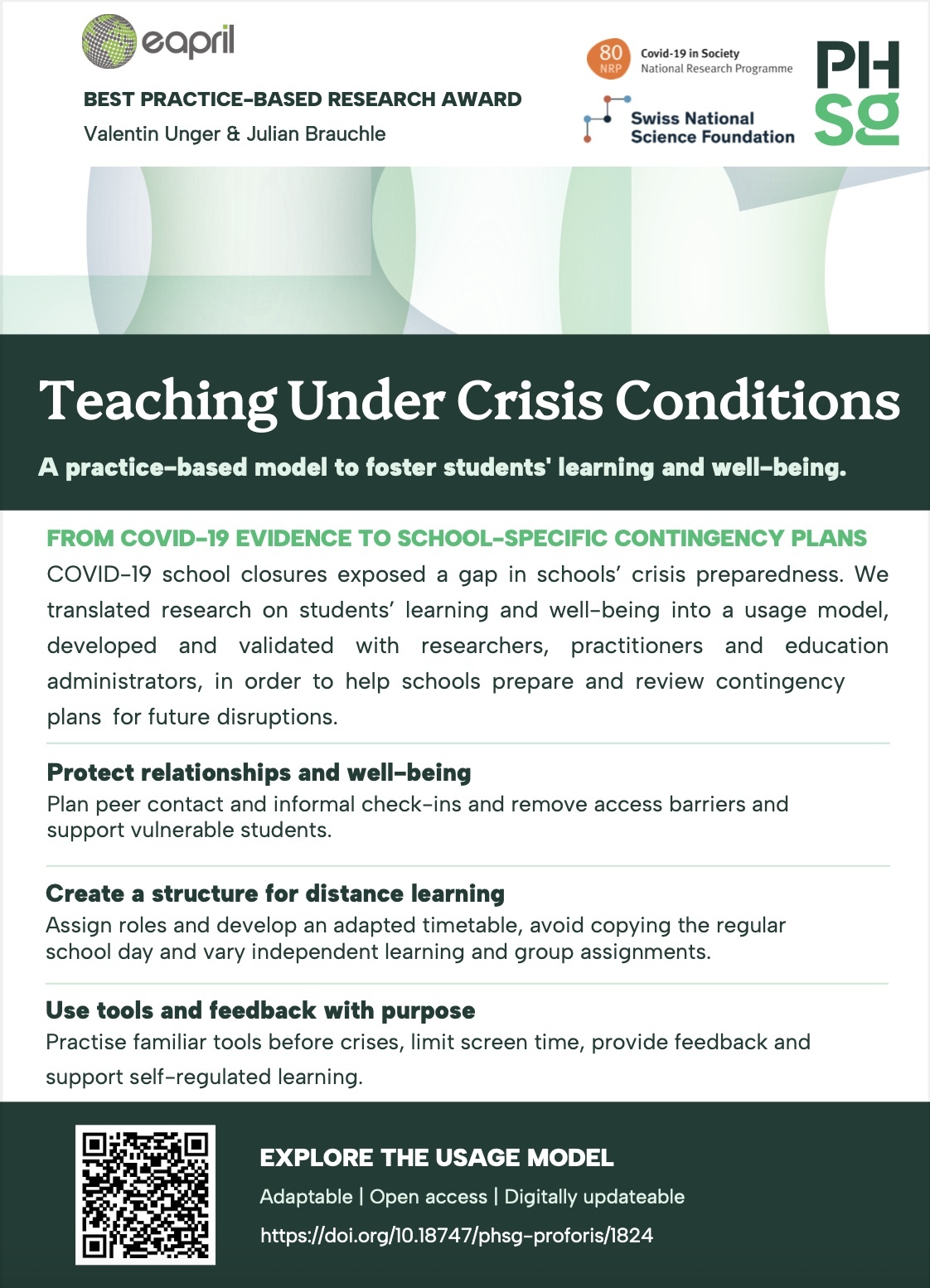
How can research findings become useful in practice? Working with teachers, education administrators and researchers, we developed, refined and validated recommendations through a multi-stage process. The result is a set of concise guidance flyers covering six key areas. At their heart are open-ended questions: How can we stay connected with every student? How should distance learning be structured? How can we monitor learning progress and well-being? As schools differ considerably in their available resources and organizational conditions, these questions help schools and education authorities develop contingency plans tailored to their specific circumstances.
The flyers’ QR codes link to the underlying research and practical resources, including sample timetables and implementation ideas. The flyers are freely available in English and German.
We are delighted that our guidelines have been nominated for the EAPRIL Best Practice-Based Research Award 2026. We will present them at the Award Session in Cork; our short video pitch offers a preview.
Our three guiding ideas are simple: Create relatedness. Provide structure. Enhance well-being.
The best preparation for the next school closure begins while schools are still open.
Share this post
About Valentin Unger & Julian Brauchle
St.Gallen University of Teacher Education