
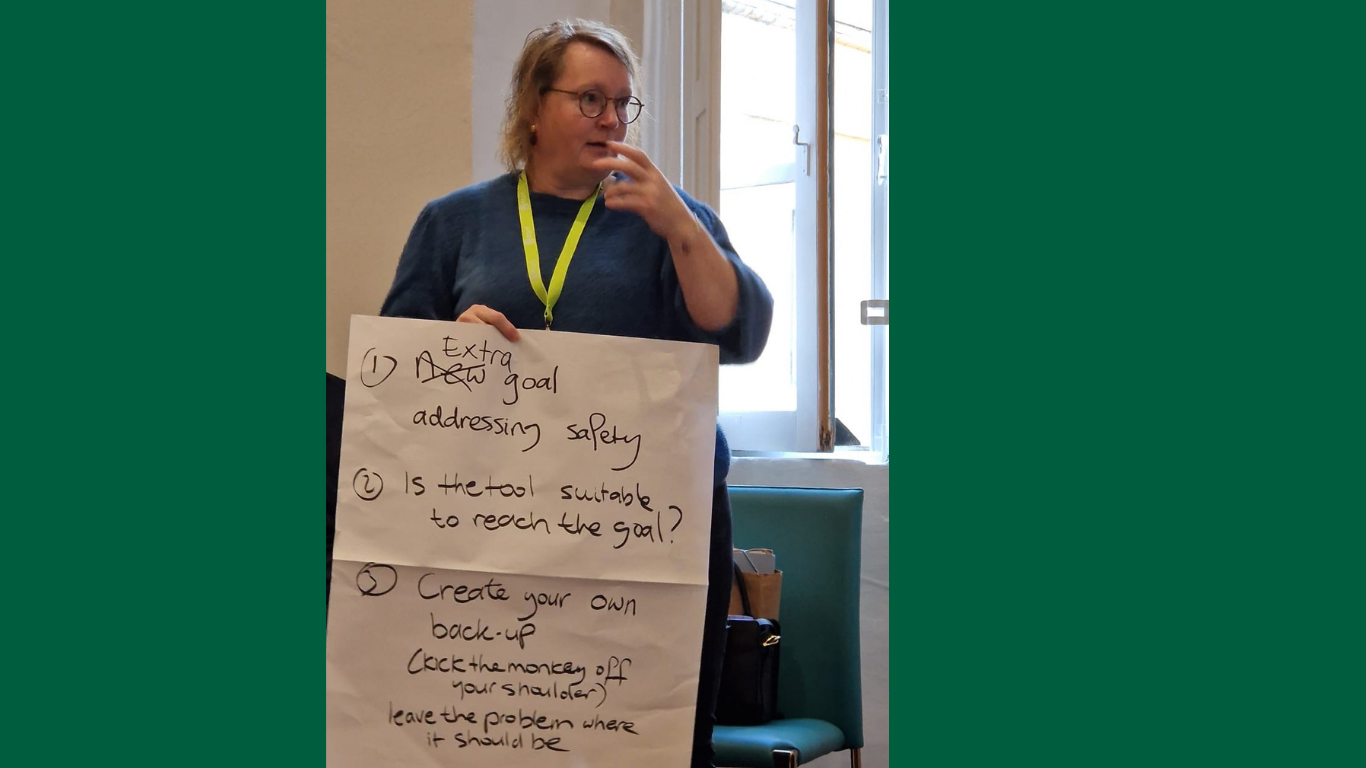
“It felt quite daunting to expose my struggles as a practitioner-researcher to a group of EAPRIL participants. But it turned out to be incredibly valuable!”
Where did I find these solutions?
During the workshop by Remco Coppoolse and Patricia Brouwer on Change Lab Methodology at the EAPRIL Conference 2025, I was invited by the group to bring in my own case. The aim was to use Cultural-Historical Activity Theory (CHAT) (Engeström, 1987) to explore a case in depth and make the underlying frictions explicit. By doing so, we hoped to collectively arrive at possible solutions. And we did!
The case I brought in:
Within my Professional Doctorate (PD) trajectory, I work with teams on collaborative inquiry based working. The case I presented during the EAPRIL workshop concerned a team with which I was planning to facilitate a reflection session. Prior to this session, I had conducted several interventions with individual team members. These interventions revealed that psychological safety within the team was insufficient and had never been openly discussed. Through my interventions, this lack of psychological safety became physically visible in a team drawing. My main struggle concerned how to ensure psychological safety during the upcoming reflection session.
Using CHAT and through the probing questions posed by the EAPRIL participants, we were able to identify the frictions present in my research practice. This helped us focus on those frictions and led to a key insight: psychological safety within the team is not my responsibility as a researcher, but the responsibility of the group itself. Here is an expression for: get that monkey off your back. In Dutch this is captured by the expression “haal het aapje van je schouder[HS1] ”; leave the problem where it belongs.
From this insight, we came to three concrete solutions:
- Do not introduce a new goal for the meeting but add an intermediary goal: explicitly address psychological safety.
- Critically examine whether the design of the meeting is suitable for achieving the intended goals.
- Create your own back-up. A team member who is informed about what is happening, or a supervisor who knows both the team and the process. Someone who can stand next to you in the process and with whom you can spar independently about the team and the process.
My four actions following this fruitful EAPRIL 2025 workshop
- I embraced the possible solutions that came out of the reflection session. I added the new goal and discussed this revised approach with the team leader. This enabled me to “take the monkey off my back.”
- I then discussed the new approach with my supervising professors and field supervisors within my PD trajectory. Before and after the team meeting, I reflected with them on both the session and my role as a researcher. In this way, I created my own back-up.
- At the start of the meeting, I explicitly stated that I had identified concerns regarding psychological safety. I then asked for permission to share these concerns within the group. The reflection session was subsequently used to establish new agreements about collaboration.
- After that, we reflected on my research topic, and psychological safety was discussed extensively by those involved
Never expected yet received!
So special how the outcome of a workshop in April leads to a solution for my practice case in my Professional Doctorate trajectory.
Hungry for more, or contact? Emely Meijerink e.meijerink@carmelhengelo.nl
Share this post
About Emely Meijerink
Contact: e.meijerink@carmelhengelo.nl