
As students increasingly have to balance academic, professional, and personal responsibilities, demand for flexible learning options in higher education is growing. However, this shift presents challenges: limited empirical evidence on flexible formats and new demands on educators, particularly in course design and student engagement. To address these issues, a four-year practice-based research project explored the implementation of flexible learning study program, leading to the development of the myScripting design toolkit.
What we learned from our research
Drawing on data from over 133 courses, the project demonstrated that blended learning with reduced classroom time can achieve outcomes equivalent to traditional instruction—provided it is supported by thoughtful, evidence-based design 1, 2. Methodological advances included contributions to equivalence testing 3 and a systematic review of blended learning with reduced classroom time 4.
How workshops became an educational design assistant
At the heart of the project were collaborative scripting workshops. These proved to be a powerful way to help educators design blended courses. The myScripting toolkit emerged from these sessions, comprising a hands-on manual 5, tutorials 6 and the online course Digital Learning Design 7. Developed in an agile, interdisciplinary process with instructional designers, software developers, educators, and users, myScripting was created through rapid design sprints involving extensive prototyping, testing, and refinement 8.
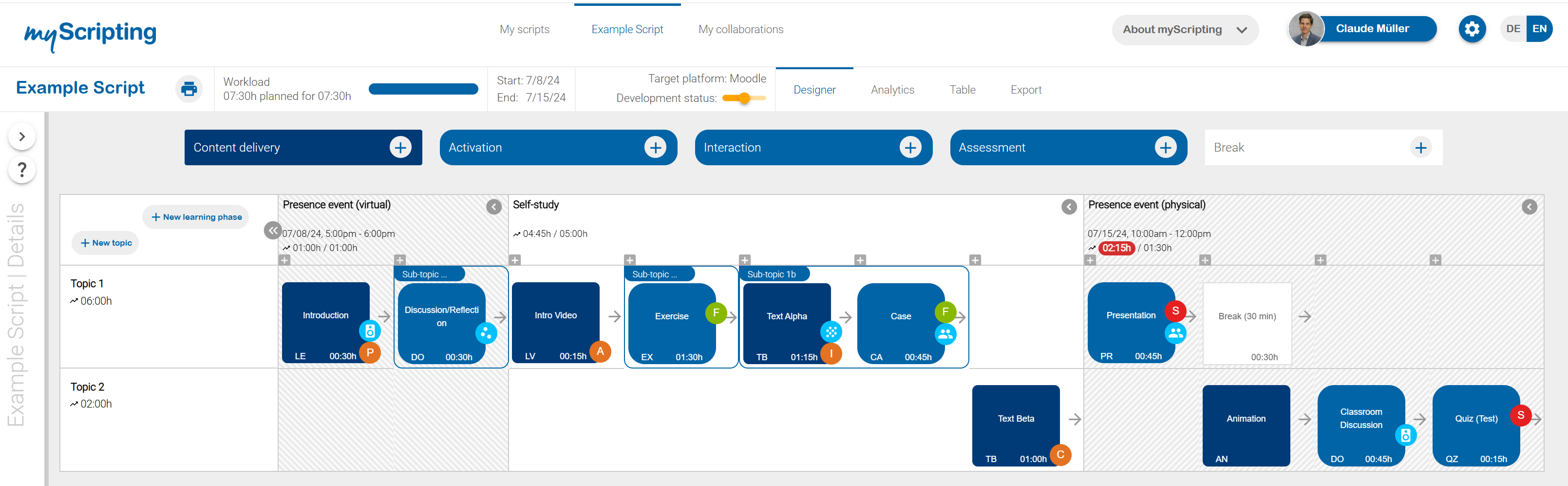
The open-access toolkit supports educators in creating engaging and effective digital learning environments by guiding them through the instructional design process. It integrates proven pedagogical principles with AI support and analytics, making research-based design strategies accessible and actionable. myScripting is now embedded in several faculty development programs and has attracted more than 2,000 users worldwide.
Key lessons from the project
- Flexible learning responds to genuine student needs and can be implemented without compromising learning outcomes.
- High-quality design, strong stakeholder engagement, and institutional support are critical to the success of blended and online learning.
- Well-designed educational design tools such as myScripting can empower educators to deliver engaging, efficient, and effective digital learning experiences.
By embedding research into practice, this project provides a scalable, sustainable model for digital transformation in higher education, making a significant contribution to the field of learning design.
Claude Müller & Jennifer Erlemann
Share this post
About Prof. Dr. Claude Müller Werder
Head Center for Innovative Teaching and Learning
ZHAW Zurich University of Applied Sciences
Switzerland